
B2B companies reach accounting professionals without cold outreach by placing useful thought leadership where accountants already go to learn: professional association resource libraries. Lead Marvels distributes advertisers’ white papers, guides, research, and case studies through association-based libraries, then turns content requests into leads that meet agreed campaign criteria. The request arrives because the professional chose the topic, which makes the first conversation welcome rather than intrusive.
What are accounting professionals trying to solve right now?
Advisory growth, workflow modernization, and staffing are the three themes accounting firm leaders keep working on, and each looks different depending on who inside the firm you are trying to reach.
Advisory growth is primarily a partner-level conversation. Moving a firm from compliance work toward advisory services raises questions partners own: which services to build, how to price them, and how to reposition client relationships. A resource pitched at staff about advisory growth will be read by the wrong people.
Workflow modernization plays out differently by firm size. A solo practitioner or a small firm weighs a change to its tax workflow personally and can decide within a week. A regional firm with dozens of professionals involves managing partners, practice leads, and IT in a decision that takes months. The same topic needs different framing for each.
Staffing touches everyone, but shows up differently at each level. Partners feel it as capacity pressure during busy season; managers feel it as workload distribution; staff feel it as early-career development and workload. Timing matters too: picture a regional firm planning its next year. Headcount and budget decisions get made in the months before filing deadlines arrive, because once busy season starts, the work leaves little room for anything else.
Pick the theme that connects to what your company sells, then pick the role that owns the decision about that theme. The rest of this guide assumes you have made both choices.
Why does cold outreach struggle with this audience?
Cold outreach struggles with this audience because of timing, not interest. An accountant’s attention runs on the firm’s calendar: client deadlines first, everything else after. A cold pitch arrives whenever your sequence schedules it, which means it often lands mid-busy-season, competing with the work in front of the reader.
A request for content arrives whenever the professional has a reason to learn. When a CPA downloads a resource on K-1 workflow automation in April, they have told you exactly where their attention is. That context is what a cold sequence cannot supply.
Thought leadership flips the dynamic. The professional initiates contact by requesting the resource, so the first interaction starts from their question, not your quota. A request shows interest in the content, and the campaign’s agreed criteria determine when it becomes a lead for your team. That is the working definition of accounting industry lead generation built on intent rather than interruption.
Why are association resource libraries a trusted setting?
Many accountants meet continuing professional education requirements through their state societies and professional associations, so the association is already part of how they learn. Its resource library inherits that habit: checking the library for a guide or research is a normal professional behavior, not a marketing encounter.
The CalCPA Knowledge Hub is one example of the setting. Accounting professionals use it to find educational content from companies and experts.
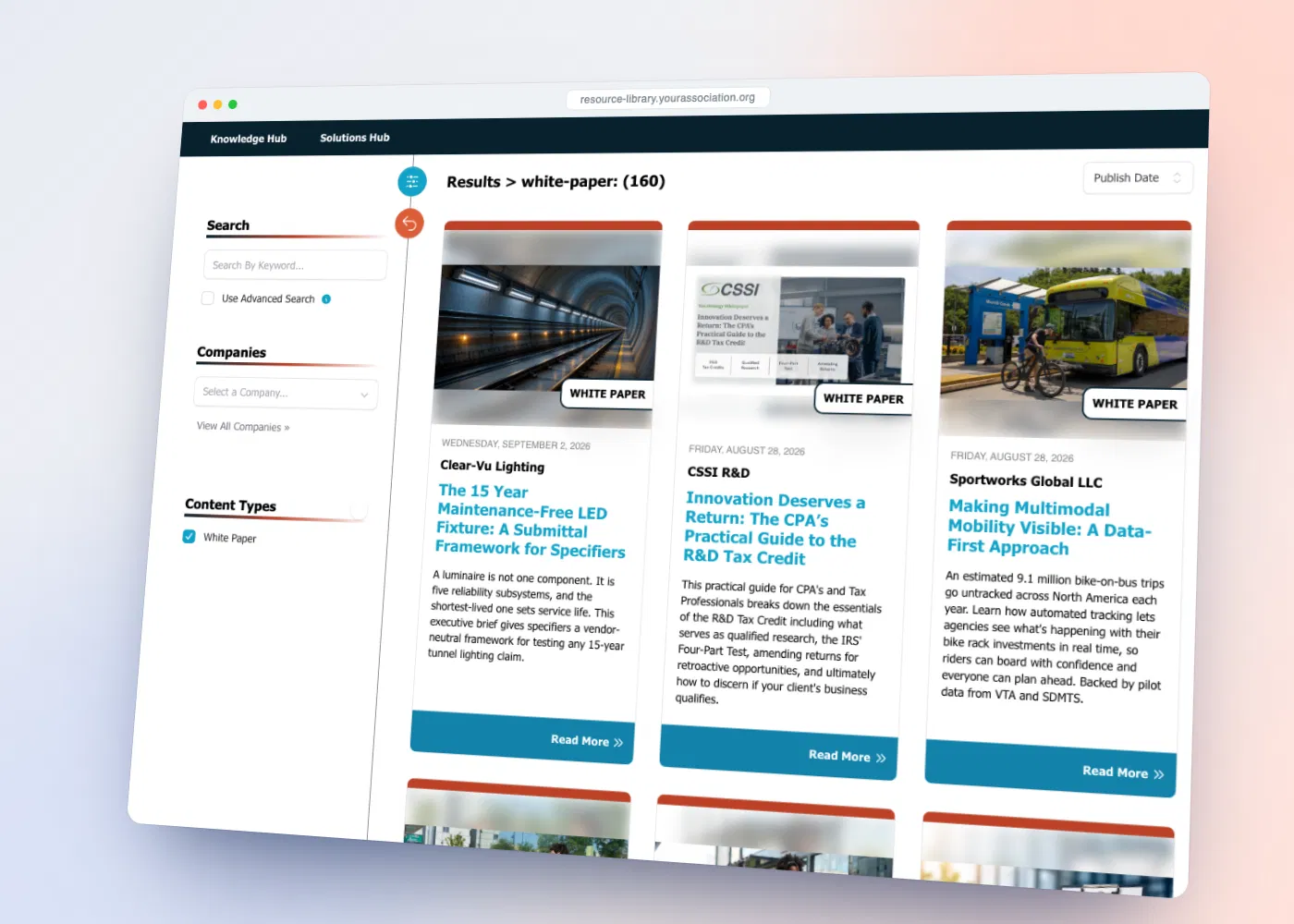
That setting does two things cold outreach does not. It carries the association’s credibility, so a firm that has never heard of your company encounters its expertise under the association’s roof. And it reaches professionals a prospect list would miss. The Lead Marvels network includes more than 100 association partners and reaches more than 5,000,000 professionals across 13 industries, accounting included. Lead Marvels turns content requests into leads that meet agreed campaign criteria.
When you target professionals by audience, the association environment supplies the context that makes a first touch feel earned rather than random.
What content earns attention from CPA firms?
Content that earns attention from CPA firms does three things: it respects their time, it addresses a decision they actually own, and it reads as professional education rather than product literature.
Two placements in the CalCPA Knowledge Hub show the pattern. Intuit’s white paper, “Fueling Forward: From Compliance to Advisory,” addresses advisory growth. A Thomson Reuters case study covers a CPA firm’s workflow modernization.

Notice what the two placements have in common: the educational value stands on its own. A partner who never engages with the sponsoring company still finishes the resource knowing more about their own problem. That standard matters when marketing to accountants, because the resource competes with client work for their attention.
Match the depth to the decision. Partners evaluating a multi-year shift toward advisory services want the practice-level view; staff working through a workflow change want the operational detail. Both kinds of resources can run as content syndication placements in the same association library; what changes is the role you write for.
How should you follow up after a content request?
Follow-up works when it continues the conversation the professional started. A requester of a workflow case study has signaled a workflow interest, and a requester of the advisory white paper has signaled a strategy interest. Your next message should pick up that thread.
A sequence built around how accounting firms work:
- Write to the role. A partner weighing advisory services needs the firmwide picture, and a manager running a workflow change needs the how-to detail. One requester list contains both roles, so segment your follow-up before the first message goes out.
- Watch the firm’s calendar. A request that lands mid-busy-season still signals real interest, and the requester’s attention arrives after filing season. Send a short note now, and hold the substantive conversation until the deadlines pass.
- Continue the requester’s topic. A follow-up that adds one relevant insight or a companion resource continues the exchange, and a pivot to your product catalog breaks the exchange.
- Use what the request told you. The advertiser dashboard gives your team campaign, lead, and analytics information. Follow up on the resource each person requested instead of guessing.
Picture how this plays out for a firm that requested a workflow case study in the middle of tax season: your team sends a two-line confirmation, waits until filing deadlines pass, then opens with a companion resource on the same workflow. The conversation resumes when the firm has time for it.
Frequently asked questions
When is the best time of year to reach accounting professionals?
After filing deadlines pass. Partners and managers step back from compliance work and turn to planning, which is when longer resources get read. Campaigns timed to those windows reach professionals while they are deciding what the next year looks like.
Should I target partners or staff-level accountants?
Target whoever owns the decision your product touches. Partners control budgets and service direction, managers own operational choices, and staff influence the tools they use daily. A resource aimed at the wrong level gets read by people who cannot act on the topic.
Does this work for small firms or only large ones?
It works for both, with different expectations. A small firm’s decision-maker is the same person doing the work, so a single useful resource can move that firm quickly. Larger firms need content that speaks to each role in the evaluation, and the association library reaches professionals at both ends of that range.
How do CPE requirements affect content strategy?
Continuing education is a standing obligation for CPAs, which means these professionals are already in a learning mindset on a recurring schedule. Educational resources fit that routine; sales pitches interrupt it.
When you’re ready to reach CPAs where they already go to learn, request a campaign.